Training
Muscle Loss After 50: Sarcopenia, Testosterone and What Actually Slows It
The first sign is rarely dramatic. A jar lid that used to give in easily now needs a tea towel. The suitcase feels heavier going into the car. Getting up off the sofa takes a push from the armrest that you did not used to need. Most men put it down to being a bit out of shape, or just getting older.
Often it is something more specific. From around middle age, the body slowly loses muscle and strength, and in some men that loss speeds up enough to have a name: sarcopenia. It is one of the biggest reasons people lose their independence in later life, and it is far more preventable than most realise.
Testosterone plays a part, but probably not the part you have been sold. Here is what the evidence says about muscle loss after 50, how much hormones matter, and what actually slows it down.
How much muscle do men lose?
Muscle mass usually peaks somewhere in your twenties or thirties. After that, commonly quoted estimates put the loss at roughly 3 to 8% per decade after 30, accelerating after 60. The numbers vary a lot between studies and between individuals, and inactive men lose more than active ones.
Strength falls faster than muscle size. Muscle quality changes with age: fibres shrink, the fast-twitch fibres used for power are lost first, fat creeps into the muscle, and the nerves that switch muscles on become less efficient. That is why an older man can look reasonably muscular and still struggle to climb stairs quickly or catch himself after a trip.
Worldwide, studies suggest around 10 to 16% of older people meet the criteria for sarcopenia, with much higher rates in people who are in hospital or in care.
What sarcopenia actually means
For years, doctors argued about how to define it. The current European definition, published in 2019, puts strength first. Low strength makes sarcopenia likely; low muscle mass confirms it; and poor physical performance, such as slow walking, makes it severe.
Two simple tests are used as a first step:
- Grip strength. Measured with a handheld dynamometer. In men, a grip below 27 kg is considered low.
- The chair stand test. Sitting on a standard chair with your arms folded, stand up fully and sit down five times as fast as you safely can. Taking more than 15 seconds suggests low leg strength.
Walking speed is the usual test of severity. A pace of 0.8 metres per second or slower, over a short measured distance, is a warning sign.
Why grip strength is worth knowing
Grip strength sounds trivial, but it is one of the most powerful simple health markers there is. In the PURE study, which followed nearly 140,000 adults in 17 countries, every 5 kg lower grip strength was linked with a 16% higher risk of death from any cause, and grip strength predicted death from any cause, and from heart disease, more strongly than systolic blood pressure did. Weaker grip was also linked with a modestly higher risk of heart attack and stroke. Grip itself is not the cause; it is a window into overall muscle health. Many gyms and physiotherapists can measure it in under a minute.
Where testosterone fits in
Testosterone helps build and maintain muscle. It increases muscle protein synthesis, supports the satellite cells that repair muscle fibres, and works alongside growth hormone and IGF-1. Our article on what testosterone does for muscle explains the mechanisms in detail.
Testosterone also falls with age, though more gently than many people think. In healthy men, total testosterone typically drops by around 1 to 1.5% a year from middle age, and free testosterone falls faster, about 2 to 3% a year, because the binding protein SHBG rises. Being overweight, poor sleep, diabetes and chronic illness lower it much more than age alone. See our guide to testosterone levels by age for typical ranges.
So it is reasonable to ask whether replacing testosterone would stop muscle loss. The trials give a fairly clear answer: it helps a little, and exercise helps a lot more.
What the testosterone trials found
The largest placebo-controlled trials designed to test testosterone's effects on physical function in men aged 65 and over are the Testosterone Trials, published in 2016. They enrolled 790 men aged 65 and over with low testosterone, below about 9.5 nmol/L (275 ng/dL), and gave them testosterone gel or placebo for a year.
Testosterone raised levels into the normal range for young men, improved sexual function and mood a little, and, in follow-up reports from the same trials published in 2017, increased bone density and corrected mild anaemia in many men who had it. On physical function, the results were modest. Men on testosterone walked a little further in six minutes than men on placebo when all the trials were pooled, but in the trial focused specifically on men with limited mobility, the main measure of improvement was not met.
Across many smaller trials, testosterone therapy in older men with low levels consistently adds some lean mass, typically a kilogram or two, and a little strength. That is real, but on its own it rarely translates into the kind of change that keeps a man walking briskly, climbing stairs and getting up from the floor unaided. Testosterone therapy also has risks and needs monitoring, as covered in TRT side effects and TRT and heart health.
The sensible conclusion: if your testosterone is genuinely low and you have symptoms, treating it may make training easier and add a little muscle. If it is normal, there is no good evidence that taking more will protect your muscles. Either way, it is not a substitute for loading them.
What actually slows muscle loss
1. Resistance training, at any age
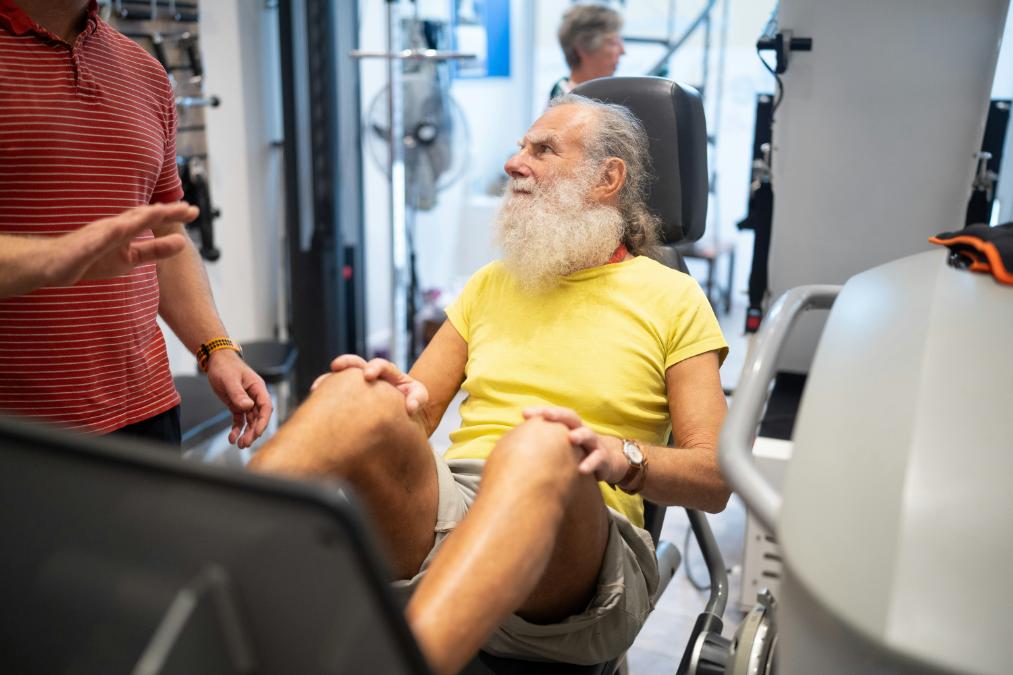
This is the one intervention that consistently works. Muscle in your sixties, seventies and beyond still responds to training, and the gains can be striking. In a famous 1990 study published in JAMA, ten frail nursing home residents aged 86 to 96 did eight weeks of supervised leg strength training. Their strength increased by an average of 174%, and their walking speed improved too.
You do not need to train like a bodybuilder. What matters is challenging the muscle enough that the last few repetitions of a set feel hard.
- Two to three sessions a week, working all the major muscle groups
- Compound movements: squats or sit-to-stands, deadlifts or hip hinges, presses, rows and carries
- Progressive load: add a little weight or a few repetitions over time
- Some power work: standing up quickly, stepping up briskly, or lighter lifts done fast, because power declines faster than strength and is what stops a fall
If you are new to training, have heart problems or joint issues, start with guidance from a physiotherapist or qualified coach. Lifting also supports testosterone itself, as our article does lifting increase testosterone? explains, and it is one of the best things you can do for bone health.
2. Enough protein, spread across the day
Older muscles become less responsive to protein, a problem sometimes called anabolic resistance. They need a bigger dose to get the same building signal. An international expert group recommends that healthy older adults aim for 1.0 to 1.2 g of protein per kg of body weight per day, and more for those who are active or recovering from illness. That is about 80 to 96 g a day for an 80 kg (176 lb) man.
Spreading it out matters too. Many older people eat very little protein at breakfast and lunch and most of it at dinner. Aiming for around 25 to 30 g at each main meal is a good rule of thumb. Our protein intake calculator works out a personal target, and our recipes include plenty of high-protein meals.
3. Creatine, alongside training
Creatine is one of the most researched supplements in sport, and it seems to work in older adults too. Meta-analyses of trials in older people show that creatine combined with resistance training leads to greater gains in lean mass and strength than training alone. A typical dose is 3 to 5 g a day. It does not work without the training, and people with kidney disease should check with their doctor first. Our creatine calculator and the answer to does creatine affect testosterone? cover the details.
4. Do not ignore vitamin D
Low vitamin D is linked with weaker muscles and more falls in older people. Supplements do not build muscle in people who already have enough, but correcting a deficiency is worthwhile. In the UK, adults are advised to consider 10 micrograms (400 IU) a day in autumn and winter. See our article on sunlight and testosterone.
5. Protect your weight and your sleep
Losing weight is good for health, but rapid weight loss without enough protein or training can strip muscle along with fat. This is particularly relevant to men using weight-loss injections, which can cause meaningful muscle loss; see GLP-1 medications and testosterone. Poor sleep and heavy drinking also undermine muscle repair and testosterone.
A simple self-check
You can get a rough idea of where you stand at home:
- Time yourself doing five chair stands with your arms folded. Over 15 seconds is worth acting on.
- Notice whether you need your hands to get up from a chair or off the floor.
- Ask yourself whether you have slowed down when walking, or avoid stairs where you used to take them.
- If your gym or physio can measure grip strength, find out your number.
If you are worried, or you have had falls, unexplained weight loss or a rapid change in strength, see your doctor. Sudden weakness has other causes that need checking.
The bottom line
Muscle loss after 50 is common, gradual and largely preventable. Testosterone plays a supporting role: treating a genuine deficiency can help a little, but it will not protect you on its own, and topping up a normal level is not the answer.
What works is unglamorous and well proven. Lift something heavy two or three times a week, eat enough protein at every meal, consider creatine, correct low vitamin D, and keep moving. It is never too late to start. The research on men in their eighties and nineties shows that muscle is still listening.
Common questions
At what age do men start losing muscle?
Muscle mass usually peaks in the twenties or thirties. After that, commonly quoted estimates suggest a loss of roughly 3 to 8% per decade after 30, speeding up after 60, with strength declining faster than size.
Does low testosterone cause sarcopenia?
It contributes, but it is one factor among many. Inactivity, low protein intake, chronic illness, poor sleep and changes in the nerves and muscle fibres themselves all matter, and exercise has a much bigger effect than hormone levels.
Will TRT stop muscle loss in older men?
In men with genuinely low testosterone it adds a little lean mass and strength, but the large Testosterone Trials found only modest effects on physical function. Resistance training does far more, and the two can be combined.
Is it too late to build muscle in my 60s or 70s?
No. Older adults still gain strength and muscle with resistance training. In one classic study, people aged 86 to 96 increased their leg strength by an average of 174% in eight weeks.
How much protein should I eat after 50?
Expert groups suggest 1.0 to 1.2 g per kg of body weight per day for healthy older adults, more if you are active or recovering from illness, spread as about 25 to 30 g per meal.
Sources: Cruz-Jentoft AJ et al., Sarcopenia: revised European consensus on definition and diagnosis (EWGSOP2), Age Ageing 2019;48(1):16-31 · Leong DP et al., Prognostic value of grip strength: findings from the Prospective Urban Rural Epidemiology (PURE) study, Lancet 2015;386(9990):266-73 · Snyder PJ et al., Effects of testosterone treatment in older men, N Engl J Med 2016;374(7):611-24 · Snyder PJ et al., Effect of testosterone treatment on volumetric bone density and strength in older men with low testosterone, JAMA Intern Med 2017;177(4):471-9 · Roy CN et al., Association of testosterone levels with anemia in older men, JAMA Intern Med 2017;177(4):480-90 · Fiatarone MA et al., High-intensity strength training in nonagenarians: effects on skeletal muscle, JAMA 1990;263(22):3029-34 · Bauer J et al., Evidence-based recommendations for optimal dietary protein intake in older people: a position paper from the PROT-AGE Study Group, J Am Med Dir Assoc 2013;14(8):542-59 · Chilibeck PD et al., Effect of creatine supplementation during resistance training on lean tissue mass and muscular strength in older adults: a meta-analysis, Open Access J Sports Med 2017;8:213-26 · Feldman HA et al., Age trends in the level of serum testosterone and other hormones in middle-aged men: Massachusetts Male Aging Study, J Clin Endocrinol Metab 2002;87(2):589-98 · Educational only, not medical advice.
Keep reading: Does lifting increase testosterone? · Testosterone and bone health · Can you raise testosterone after 50? · How much muscle can you build naturally? · TRT before and after · One-rep max calculator
Want the full protocol?
The Testosterone Blueprint covers the complete system — sleep, training, nutrition, supplements and bloodwork, with a step-by-step plan you can start this week.
Get the book →