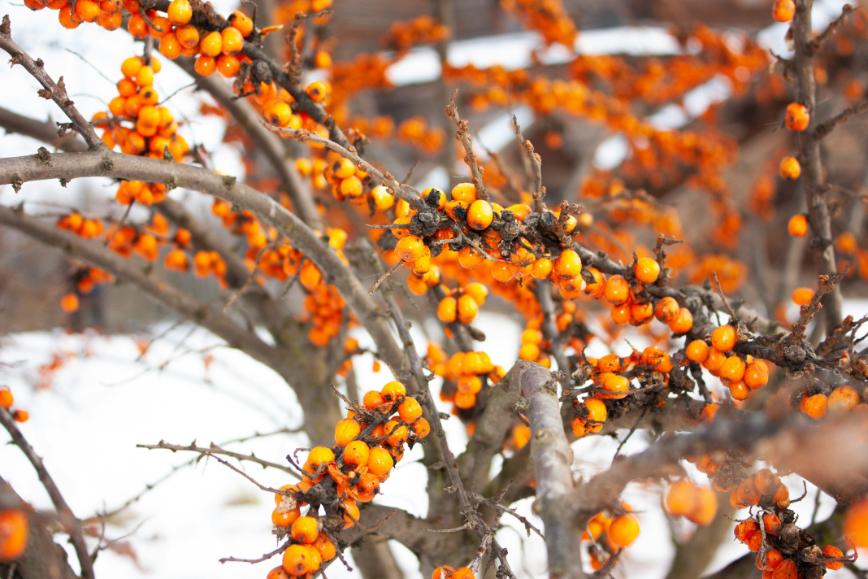
Sea buckthorn
The richest plant source of omega-7, with real trials behind it for dryness — if you buy the right oil.
At a glance
Why it matters
Sea buckthorn grows on the Baltic coast, across Scandinavia and through the Himalayas, on thorny shrubs that survive conditions almost nothing else tolerates. The berries are bright orange, unpleasantly sour raw, and contain something no other plant food does in useful quantity.
That is omega-7, or palmitoleic acid, and sea buckthorn berry oil carries more of it than any other plant source known. Your skin and mucous membranes contain it naturally, which is the reason it has been studied for dryness rather than for anything more glamorous.
What's inside
The berry oil is roughly 30 to 40 per cent palmitoleic acid, alongside cis-vaccenic acid, the other omega-7. It also carries omega-3, omega-6 and omega-9, which makes it the only plant source containing all four families at once.
Beyond the fats: vitamin C at several times the concentration of oranges, vitamin E as both tocopherols and tocotrienols, carotenoids that give the berries their colour, and plant sterols.
For men
The honest position: most of the human evidence here is about dryness and skin, and most of the trials enrolled women. There is no testosterone data worth quoting.
What does apply is the metabolic angle. Palmitoleic acid has been studied for its effects on lipid metabolism and inflammatory markers, and reducing chronic low-grade inflammation is relevant to the signal from brain to testes. That mechanism is plausible rather than proven.
Dry eyes are not a women's problem either. If you work at a screen and your eyes feel gritty by mid-afternoon, the dry eye trials apply to you as much as anyone.
For women
This is where the evidence sits, and it is better than for most things sold for the same purpose.
A randomised, double-blind, placebo-controlled trial found oral sea buckthorn oil improved vaginal epithelial integrity in postmenopausal women, with improvements in dryness and elasticity. A separate trial in people with dry eye found it attenuated the rise in tear film osmolarity through the cold season and reduced symptoms compared with placebo.
Two things worth saying plainly. The effects are modest, and this is considerably less effective than prescription vaginal oestrogen for moderate or severe symptoms. It is a reasonable addition, not a replacement.
But for mild dryness, or for a woman who cannot take oestrogen, it is one of the few non-hormonal options with randomised trials behind it rather than testimonials.
How to eat it
Buy berry oil, not seed oil. This single distinction explains most of the disappointment in reviews. Berry, or pulp, oil carries 30 to 40 per cent palmitoleic acid. Seed oil carries under 1 per cent. Both are labelled sea buckthorn.
Trials typically used around 2 g daily for about three months. Effects are cumulative rather than immediate; most studies ran eight to twelve weeks before measuring.
The berries themselves are extremely sour, which is why they are usually taken as oil, juice or powder rather than eaten. If you find juice, check whether it is diluted, as many are.
Take it with food, since the fat-soluble compounds absorb better that way.
Worth knowing
Three cautions.
It is a supplement, not a food, in practice. Nobody eats meaningful quantities of the raw berry, so the evidence is really about the oil.
Blood thinning. Sea buckthorn may have mild antiplatelet effects. If you take warfarin or similar medication, mention it.
Do not expect the stem cell claims to hold up. A single preliminary trial is sometimes cited for effects on stem cell mobilisation. One small study is where research starts, not where claims should end.
What survives scrutiny is narrower than the marketing: dryness of the eyes and mucous membranes, and skin hydration. That is a real and useful set of effects, and it is worth buying for those rather than for the longer list on the packaging.
Bottom line
The richest plant source of omega-7, with randomised trials behind it for dry eyes and vaginal dryness — provided you buy berry oil rather than seed oil, which almost nobody checks.
Related reading: What helps with hot flushes? and which supplements actually help in menopause?
Educational information, not medical advice. Foods affect people differently — if you have a medical condition, are pregnant or breastfeeding, or take medication, talk to your doctor before making big dietary changes. Some links are affiliate links — if you buy through them we may earn a small commission, at no extra cost to you.