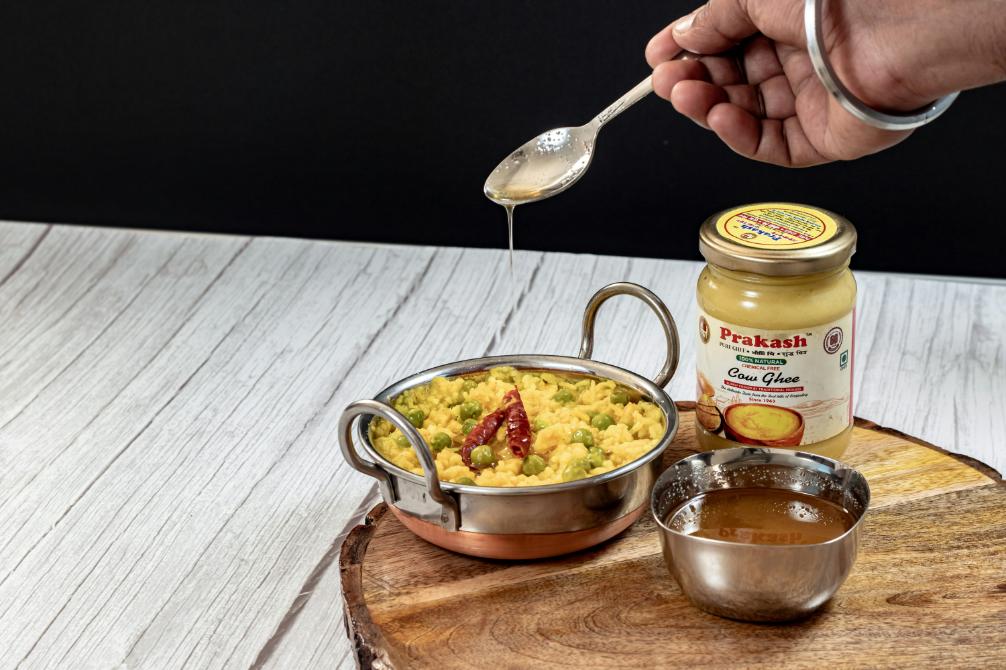
Ghee & grass-fed butter
A traditional cooking fat that supplies the dietary saturated and monounsaturated fat, and the fat-soluble vitamins, your body draws on to build testosterone — valuable in sensible amounts, easy to overdo.
At a glance
Why it matters
There's a piece of nutrition history worth knowing: the decades-long war on dietary fat quietly worked against men's hormones. Testosterone is built from cholesterol, and studies consistently show that very low-fat diets tend to lower testosterone, while diets with adequate fat support it. That doesn't mean fat is a free-for-all — but it does mean a sensible amount of quality fat belongs on a hormone-supporting plate, and traditional cooking fats like ghee and grass-fed butter are among the most stable and useful. They tolerate heat without oxidising the way delicate seed oils do, they carry fat-soluble vitamins, and grass-fed versions add vitamin K2 and CLA. The key word, and the reason this sits at "in moderation," is amount: fat supports hormones up to a point, then simply becomes surplus calories.
What's inside
The core value is the fat itself — a blend of saturated and monounsaturated fatty acids that provides the cholesterol backbone and dietary fat your body uses in steroid-hormone production. Grass-fed butter and ghee also carry the fat-soluble vitamins A, D, E and K2, with vitamin K2 especially notable for directing calcium into bones rather than arteries. Butyrate, a short-chain fatty acid, supports gut lining health, and grass-fed dairy fat contains CLA (conjugated linoleic acid), studied for modest metabolic effects. Ghee has the milk solids removed, which makes it lactose- and casein-free (useful for the sensitive) and gives it a high smoke point ideal for cooking.
For men
For men, the relevant evidence is about avoiding a deficit rather than chasing a surplus. If your diet has drifted very low in fat — a surprisingly common side effect of "clean eating" — nudging quality fat back up toward a normal share of calories is associated with healthier testosterone, and a spoon of ghee to cook your eggs or vegetables is a simple way to do it. Beyond that point there's no bonus, only calories, so the goal is adequate, not maximal. Used to cook nutrient-dense food, it's an easy, tasty win.
For women
For women, the fat-soluble vitamins are the main draw: vitamin K2 and vitamin D support the bone health that becomes a real concern as oestrogen falls, and adequate dietary fat supports the absorption of these vitamins from the rest of the meal. Ghee's lack of lactose and casein makes it a practical fat for women who find regular dairy triggers bloating or skin flare-ups. As with men, the theme is a sensible cooking amount rather than large daily quantities.
How to eat it
Use it the way it's meant to be used — as a cooking fat, not a food group. A teaspoon or two to fry eggs, roast vegetables, sauté greens or finish a dish adds flavour and helps you absorb the fat-soluble vitamins in what you're cooking. Ghee's high smoke point makes it excellent for higher-heat cooking where olive oil would struggle; grass-fed butter is lovely for lower-heat cooking and finishing. Rotate it with olive oil and oily fish so your fats stay varied rather than all saturated.
Worth knowing
This is the one "supportive" fat that comes with a real counterweight: it is high in saturated fat, and mainstream cardiology still advises keeping saturated fat modest for heart health. The resolution isn't to fear it or to bathe in it, but to use small amounts of a quality fat as part of a varied diet that also includes olive oil, nuts and oily fish. Anyone with high cholesterol or existing heart disease should be more conservative and prioritise unsaturated fats. Treated as a cooking fat in sensible portions, ghee and grass-fed butter are a genuine, traditional ally; treated as something to add by the tablespoon "for hormones," they're just extra calories.
Bottom line
Your body builds testosterone from fat, so a sensible amount of a stable, quality cooking fat like ghee or grass-fed butter genuinely supports hormones — the trick is treating it as something to cook in, not something to load on.
Related reading: Foods that increase testosterone and fellow quality fat extra-virgin olive oil.
Educational information, not medical advice. Foods affect people differently — if you have a medical condition, are pregnant or breastfeeding, or take medication, talk to your doctor before making big dietary changes. Some links are affiliate links — if you buy through them we may earn a small commission, at no extra cost to you.